
Holy Season of Advent
What is Advent?
Sunday 1st December 2024 – Tuesday 24th December 2024
Beginning the Church’s liturgical year, Advent (“ad-venire” in Latin or “to come to”) is the season encompassing the four Sundays (and weekdays) leading up to the celebration of Christmas. This Advent we begin Year C of the Sunday Cycle and Weekday Cycle 1.
The Advent season is a time of preparation that directs our hearts and minds to Christ’s second coming at the end of time, and to the anniversary of Our Lord’s birth at Christmas. From the earliest days of the Church, people have been fascinated by Jesus’ promise to come back. But the scripture readings during Advent tell us not to waste our time with predictions. Advent is not about speculation. Our Advent readings call us to be alert and ready, not weighted down and distracted by the cares of this world (Lk 21:34-36). Like Lent, the liturgical colour for Advent is purple since both are seasons that prepare us for great feast days. Advent also includes an element of penance in the sense of preparing, quieting, and disciplining our hearts for the full joy of Christmas.
As we prepare for Christmas, the General Instruction of the Roman Missal notes some differences to the Mass that should be observed during the season. For instance, the priest wears violet or purple during Advent, except for the Third Sunday of Advent (Gaudete Sunday) when rose may be worn (GIRM, no. 346). Other small changes are effected in the liturgy, the Gloria is not prayed during Mass, we wait for the celebration of the Lord’s first coming to do so again, and aesthetic changes in may include a more modestly decorated church sanctuary.
The final days of Advent, from December 17 to December 24, we focus more directly on our preparation for the celebrations of the Nativity of our Lord at Christmas. In particular, the “O” Antiphons are sung during this period, and have been by the Church since at least the eighth century. They are a magnificent theology that uses ancient biblical imagery drawn from the hopes of a coming Messiah, expressed by the Old Testament, to proclaim the coming of Christ as the fulfilment not only of Old Testament hopes, but of present ones as well.
Advent devotions including the Advent Wreath remind us of the meaning of the season. An Advent calendar can help us fully enter into the season with daily activity and prayer suggestions to prepare us spiritually for the birth of Jesus Christ.
Advent Wreath

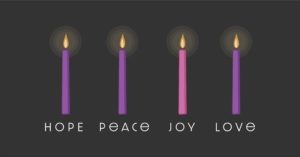
Traditionally, Advent wreaths are constructed of a circle of evergreen branches into which four candles are inserted, representing the four weeks of Advent. Ideally, three candles are purple, and one is rose, but four white candles may also be used.
The purple candles symbolize the prayer, penance, and preparatory sacrifices and good works undertaken at this time. The rose candle is lit on the third Sunday, Gaudete Sunday, when the priest may wear rose vestments at Mass. Gaudete Sunday is the Sunday of rejoicing, because the faithful have arrived at the midpoint of Advent, when their preparation is now half completed, and we are closer to the celebration of the Lord’s first coming at Christmas.
The progressive lighting of the candles symbolizes the expectation and hope surrounding our Lord’s first coming as Light of the World and also symbolizes our anticipation of his second coming to judge the living and the dead.
Advent Wreath Blessing Prayer
Lord our God,
we praise you for your Son, Jesus Christ:
He is Emmanuel, the hope of the peoples,
He is the wisdom that teaches and guides us,
He is the Savior of every nation.
Lord God,
let your blessing come upon us
as we light the candles of this wreath.
May this wreath and its light
be a sign of Christ’s promise to bring us salvation.
May he come quickly and not delay.
We ask this through Christ our Lord.
Amen.
The “O” Antiphons
The one acceptable exception to the Tv advertising, radio, and shopping mall audio music barrage during Advent is a simple chant for Advent, ” O Come, O Come Emmanuel.” This hymn-song, with its longing for the coming of the Saviour, genuinely belongs to Advent and not to Christmas. Its melody is based on Gregorian Chant, and it’s verses are all taken from the Church’s “O” antiphons. These antiphons introduce the Magnificat, or canticle of Mary, at evening prayer in the Liturgy of the Hours, from December 17th through December 23rd. Each antiphon begins with a traditional title for Christ. Each of these traditional titles for the Messiah connects the coming of Christ with the prophetic writings of the Old Testament.
In some Catholic parishes, the Sunday Liturgies during Advent feature the tune of “O Come, O Come Emmanuel” as the setting for the Holy Holy, the Great Amen, and other sung parts of the Mass. While it’s asking a lot for this simple tune to bear so much repetition for four weeks, this setting does anchor us firmly in the longing and anticipation of Advent. But the original hymn, with its pleading for Christ’s coming, still serves as a welcome antidote to the onslaught of often bad commercial Christmas music that we have to endure every November and December. It also connects us to the evening prayer of the whole Church in the last week of Advent.
December 17
O Wisdom of our God Most High,
guiding creation with power and love:
come to teach us the path of knowledge!
December 18
O Leader of the House of Israel,
giver of the Law to Moses on Sinai:
come to rescue us with your mighty power!
December 19
O Root of Jesse’s stem,
sign of God’s love for all his people:
come to save us without delay!
December 20
O Key of David,
opening the gates of God’s eternal Kingdom:
come and free the prisoners of darkness!
December 21
O Radiant Dawn,
splendour of eternal light, sun of justice:
come and shine on those who dwell in darkness and in the
shadow of death.
December 22
O King of all nations and keystone of the Church:
come and save man, whom you formed from the dust!
December 23
O Emmanuel, our King and Giver of Law:
come to save us, Lord our God!
