
Month of the Rosary of the Blessed Virgin Mary

‘I invite everyone to pray the Rosary for peace, each day of the month, individually, in the family, in community.’ (Pope Leo XIV)
~~~~~
The Rosary
Pope Leo XIV on May 31st2025 the Feast of the Visitation of the Blessed Virgin Mary participated in a Rosary procession and vigil in the Vatican Gardens to conclude the Marian month of May. He led the faithful following the path of the Joyful Mysteries, praying before the Vatican Lourdes Grotto and reflecting on Mary’s role in faith. This event marked the end of May with a renewed invitation to pray the Rosary daily for peace, as encouraged by the Virgin of Fátima.
Pope Leo led prayer offering a message of faith under Mary’s maternal mantle. The Holy Father renewed the invitation to pray the Rosary daily, referencing the Virgin of Fatima’s call for peace and stressing the importance of disarming hearts and not closing them off to God’s gifts. The event highlighted Mary’s role as a maternal intercessor and a foundation for faith.
The Holy Father encouraged everyone to look at their lives as a journey of faith. “Let us then look at our lives as a journey following Jesus, to be walked, as we did this evening, together with Mary“, he said, before inviting the faithful to ask the Lord for the grace to praise Him daily, not only in words but in the way we live.
~~~~~

The development of praying The Rosary
The Poor Man’s Breviary
An important development in the history of the rosary is found in its roots in the liturgical prayer of the Church. In the medieval period, there was a desire to give the laity a form of common prayer similar to that of the monasteries. Monastic prayer was structured around the Psalter—the recitation of all 150 psalms from the Bible. At that time, however, most laity could not afford a Psalter, and most could not even read.
As a parallel to the monastic reading of the 150 psalms, the practice developed among the laity of praying the Our Father 150 times throughout the day. This devotion came to be known as “the poor man’s breviary.” The laity were eventually given beads to help them count their prayers.
Marian devotion followed a similar pattern. Gabriel’s words, “Hail Mary, full of grace, the Lord is with you” (Luke 1:28), sometimes were read in the monasteries at the end of a psalm, showing how the psalms found fulfilment in the New Testament with the coming of Christ through the Virgin Mary. Some laity began to recite these words in the manner of the Our Father—150 times, while counting their prayers on beads. In repeating the words of Gabriel, they were reliving the joy of the annunciation and celebrating the mystery of God becoming man in Mary’s womb.
Christians linked this prayer with Elizabeth’s words to Mary at the Visitation: “Blessed are you among women and blessed is the fruit of your womb” (Luke 1:42). Finally, with the addition of the name “Jesus” in the thirteenth century, the first half of the Hail Mary was in place. This early form of the Hail Mary was recited 150 times on the beads. By the fifteenth century, the 150 Hail Marys had been divided into sets of ten, known as “decades,” with an Our Father at the beginning of each.
~~~~~
Meditating on ‘Mysteries’
Another line of development in monastic prayer eventually led to the practice of contemplating Christ’s life while reciting the Hail Marys. Some monasteries began associating the psalms with an aspect of Jesus’s life. At the end of each psalm, the monks would recite a phrase relating that psalm to the life of Jesus or Mary. Taken together, these phrases formed a brief life of Christ and his mother.
A devotion that joined fifty of these phrases with the praying of fifty Hail Marys began in the early fifteenth century. However, since fifty points of reflection generally could not be recalled without a book, the devotion was simplified by reducing the meditation points to fifteen, with one for every decade.
The Rosary’s defining moment came during an apparition of Mary to Saint Dominic around the year 1221. Dominic was combating a popular heresy in France called Albigensianism. Mary gave him the rosary, told him to teach people this devotion, and promised that his apostolic efforts would be blessed with much success if he did. We know the religious order Dominic founded (the Dominicans) clearly played a major role in promoting the rosary throughout the world in the early years of this devotion. By the end of the fifteenth century, the basic structure of the rosary was in place: Our Fathers dividing decades of Hail Marys, with meditations on the life of Christ and Mary.
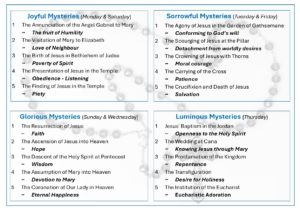
In the sixteenth century, the sets of five Joyful, five Sorrowful, and five Glorious Mysteries as we know them today began to emerge. Also, the vocal prayers of the rosary were finalised. The ‘Glory Be’ was added to the end of every decade, and the second half of the Hail Mary was formalised: “Holy Mary, Mother of God, pray for us sinners now and at the hour of our death. Amen.” In 1569, Pope Saint Pius V officially approved the rosary in this form: fifteen decades of Hail Marys introduced by the Our Father and concluded with the Glory Be.
‘Luminous Mysteries’
And so the rosary remained for over four centuries. Then, in 2002, Pope Saint John Paul II proposed something new when he published his Apostolic Letter on the Most Holy Rosary, Rosarium Virginis Mariae. The letter announced the Year of the Rosary and called on Catholics to renew their devotion to this traditional prayer and the proposal of a whole new set of mysteries for contemplation in the rosary, the “Mysteries of Light” or ‘Luminous Mysteries.’
John Paul II suggested that reflection on the mysteries of Christ’s public ministry would help Catholics enter more fully into the life of Jesus through the rosary: “To bring out fully the Christological depth of the Rosary it would be suitable to make an addition to the traditional pattern which…could broaden it to include the mysteries of Christ’s public ministry between his Baptism and his passion” (RVM, 19). The pope proposed the following scenes to be contemplated: (1) Christ’s baptism, (2) the wedding feast at Cana, (3) the proclamation of the kingdom, (4) the Transfiguration, and (5) the institution of the Eucharist.
The pope’s invitation to reflect on these mysteries makes a lot of sense. As some have noted, in the traditional form of the rosary, the transition from the fifth Joyful Mystery to the first Sorrowful Mystery seemed rather abrupt. We moved from Jesus as a twelve-year-old boy found by his parents in the temple to Jesus as a 33-year-old man about to be crucified on Calvary. The Mysteries of Light fill in the gap.
The pope also said he hoped the addition of new mysteries would give the rosary “fresh life” at a time when the rosary was devalued in many parts of the Church. He hoped this new vitality would help “enkindle renewed interest in the Rosary’s place within Christian spirituality as a true doorway to the depths of the Heart of Christ, ocean of joy and of light, of suffering and of glory” (RVM, 19). Indeed, the Mysteries of Light seem to be not only a most fitting development of the rosary, but also a providential one for our age and one that is likely to stand the test of time.
~~~~~


